
"I'm just independent."
"I have high standards."
"I hate conflict."
People say sentences like these the way they state their height, and usually there is some truth in them. But notice when they come out. I'm just independent tends to appear when someone offers help. I have high standards explains why nothing is ever finished. I hate conflict is the reason a hard conversation has waited three months.
The fourth chapter of my book, Who's Leading? Unmasking the Buried Intelligence That Shapes Your Life, is about how sentences like these get written. Many began as rules for getting through something, and over years of repetition they stopped feeling like rules and started feeling like you.
This is Part 4 of a series walking through the book ahead of its release on November 10, 2026. Part 1 introduces the question the book is named for, Part 2 covers the mask, and Part 3 the feeling that arrives bigger than the moment. Sara Veillon, the book's editor, co-created its framework with me.
How an old rule gets written
The book proposes a sequence. It begins with a Foundational Event: an experience, or a pattern of experiences, that shaped what you learned about danger, belonging, worth, dependence, power and pain. It does not have to be dramatic. A caregiver withdraws affection when a child gets angry. A mistake brings humiliation instead of guidance. A child learns that peace returns only when they become quiet, useful or agreeable. Not everyone can point to one decisive event, and the framework does not require one.
What you learned in those moments becomes Buried Intelligence, the emotional and bodily knowledge you carry about what happened and what seemed to make it stop. Much of it forms before a child has words, or the perspective to explain it fairly.
Repeat a partial conclusion often enough and it becomes survival propaganda: I am too much. My needs create problems. People leave. If I am not in control, I will be hurt. Nobody is lying on purpose. Propaganda here means a partial conclusion repeated until it feels unquestionable, one painful experience turned into a permanent prediction.
The propaganda then supports a Survival Order, a command with a threat attached. The order does not merely say avoid conflict. It says avoid conflict, or you will lose love. It does not merely say perform well. It says perform well, or you will become worthless.
A Protective Agent, the book's name for the strategy that carries the order out, does the work. Then comes the step that locks it in: temporary relief. The child goes quiet and the criticism stops. The system reads that relief as proof that obedience is what kept it safe.
From a message to a bylaw
A Survival Order rarely stays a single rule. The book traces how it moves deeper, using fear as the example.
First it is a message: do not show fear.
Then a rule: fear must always be hidden.
Then a belief: people do not respect anyone who appears afraid.
Then an identity: I am the strong one. I do not get scared.
Finally it works like a bylaw, an internal law saying that anyone who threatens this identity must be resisted, discredited, controlled or excluded. "At that point," the book says, "revising the order can feel like losing the self."
This is why people defend a pattern they already admit is hurting them. Once an order has become an identity, it stops feeling like something you do. It feels like evidence of who you are. The Controller says, I am simply responsible. The Performer says, I have always been driven. The Pleaser says, I am just a caring person. The Withdrawer says, I am independent and do not need much.
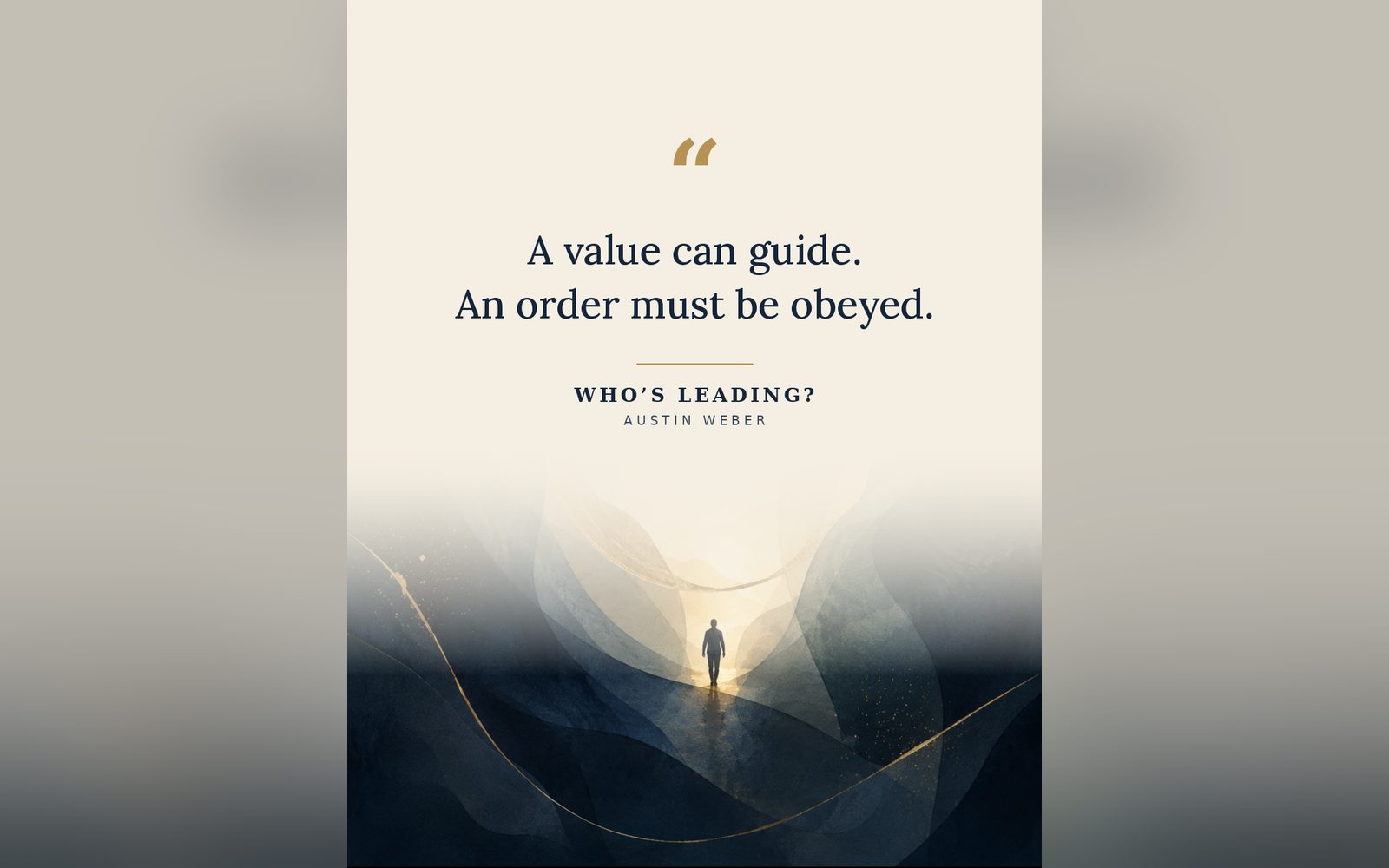
A value can guide. An order must be obeyed.
Each of those identities holds something real. The trouble lies with the bylaw that makes the quality compulsory and punishes anything outside it.
A person who is free to be responsible can also rest, delegate, and tolerate someone else's way of doing it. A person governed by responsibility has to manage everything or face the terror of being careless, powerless or unworthy.
You can run the same test on your own sentences. If you are independent, can you accept help when you are worn out? If you have high standards, can you call something finished? If you hate conflict, can you disagree with someone you love and stay in the room? When the honest answer is no, you may be looking at an order rather than a value.
Safety is not the same as control
Old orders often confuse the two, so the book defines them.
Safety is the capacity to respond to reality with resources, boundaries, support, discernment and choice.
Control is the attempt to eliminate uncertainty before it can awaken old pain.
A Survival Order promises safety if you can control enough: every mood, every outcome, every mistake, every impression. That promise cannot be kept, because relationships include disappointment and parenting includes helplessness. And when control fails, the order rarely decides control was the wrong tool. It decides you did not control enough, and tightens its grip. From outside, that looks like stubbornness. From inside, it feels like survival.
Why the old rule argues with good news
You might expect a kind partner to quietly retire an old order. Often the reverse happens. If the order says no one can be trusted, one reliable relationship can feel destabilizing rather than comforting. So the order files the evidence as an exception:
They are kind now, but wait until they know the real me.
This relationship feels safe because I have not made a mistake yet.
That is why a new sentence on its own seldom changes much. In the book's view, an order may shift through repeated experience: truth told with discernment, uncertainty tolerated, repair that actually happens, and feared outcomes checked against what really occurs. Progress varies, and nothing guarantees it.
Maya's order to conceal
Maya and Daniel are the fictional couple readers follow through the book. In conflict, Maya goes quiet and careful, and Daniel feels her distance as rejection.
As a child, Maya became intensely upset during a family argument, and a frightened adult told her that her feelings were making everything worse. She had no way yet to separate having a strong emotion from causing harm, so she concluded: What lives inside me can hurt the people I love. The order that followed was faster than the feeling: Conceal it. Control it. Keep people at a distance until you are composed. Over time it became identity: I am the controlled one. I am the responsible one. I do not get to fall apart.
Where Daniel sees coldness, Maya experiences restraint, a way of protecting everyone from what might happen if she let the feeling out.
Daniel carries an order of his own. His father valued certainty and speed, and a wrong answer could become a family story told at Daniel's expense. The propaganda: If people see uncertainty, they will humiliate you. Maya's follow-up questions come from another of her orders, track everything, and they meet his: defend immediately. Each produces exactly what sets the other off.
Rewriting an order without going to war with it
People often try to change by treating the old rule as an enemy. The book warns that this starts another internal war, because protection grows more defensive when it hears you are the problem. The alternative is to keep the protective intention and change the method. The book calls the result a Protective Order: a new rule, written on purpose, for the life you have now. Three of the book's rewrites:
- Keep everyone happy becomes Care about impact without abandoning truth.
- Never make a mistake becomes Prepare responsibly, acknowledge mistakes, and use repair rather than perfection to protect connection.
- Hide what you feel becomes Share emotion with discernment, regulation, and people who have demonstrated the capacity to receive it.
Maya's revision keeps what her order was trying to protect: My emotions require awareness, regulation, practice, and accountability; they do not require shame or disappearance. I can request space and remain in relationship. I can return when I say I will. Daniel's reads: A question is not automatically a verdict. I can admit uncertainty, correct a mistake, and remain worthy.
None of this excuses impact. An understandable order can still authorize harm, and the book holds both: I understand why this order was written. I also recognize that the person in front of me should not have to pay for an emergency they did not create.
Try it: review an old order
Pick one recurring rule and write it in its most absolute form. Listen for always, never, must, cannot and should. Then complete this sentence:
To remain safe, loved, respected, or in control, I must ____.
Now ask a few of the book's questions:
- What experience first made this order believable?
- What does it say about me, and about other people?
- What relief does obeying it give me, and what does it cost me now?
- Where has the predicted catastrophe not happened?
Finish by writing a Protective Order: The intention I want to preserve is ____. The method that must change is ____. My protective order is ____.
Read it aloud and notice any objection. Resistance does not prove the revision is wrong. It may only mean the old prediction still feels believable.
What this is, and what it is not
The orders and agents here are metaphors in a proposed model, not a diagnosis or a proven treatment, and Maya and Daniel are a composite. Move slowly, and if this exercise stirs up trauma, overwhelming distress, urges to harm, or a relationship that does not feel safe, stop and reach for qualified support. If you are in crisis, call or text 988, or call 911.
Questions people ask about old rules
What is a Survival Order?
In Who's Leading?, a Survival Order is an old rule written to stop an earlier pain from happening again, such as Never depend on anyone or Keep everyone happy. It usually carries a threat: obey, or the thing you fear will happen. Each one made sense when it was written. The question is whether it still deserves authority now.
Is being independent a bad thing?
No. Independence, high standards and care are real values. The book's distinction is between a value, which can guide you, and an order, which must be obeyed. If you cannot accept help when you need it, or cannot finish anything because it is never good enough, the quality may have hardened into a rule.
Do I need a traumatic event to have a Survival Order?
No. The book calls the experiences that shape these rules Foundational Events, and they can be small or repeated: a need met with irritation, a mistake met with humiliation instead of guidance, a conflict that was never repaired. Not everyone can identify one decisive event, and the framework does not require one.
When is Who's Leading? coming out?
Who's Leading? comes out on Amazon on November 10, 2026, in paperback and on Kindle. See it on Amazon.
Next in the series
Part 5 meets the Protective Agents who enforce these orders, from the Controller to the Withdrawer, and helps you recognize the one you tend to lead with.
If you would rather not untangle an old order alone, you can read about my work or Sara's, look at individual counseling or couples counseling, or get in touch. The always, never and should that this exercise listens for are close cousins of the should statements we have written about before.
The question to carry until then: Which of my rules was written for a danger that has already passed?