
"Did you remember to call the contractor?"
That ordinary question opened this series, and it is the first scene of Maya and Daniel's story in the book. Daniel walks into the kitchen, Maya asks it before he has taken off his coat, and within seconds he is answering a different question: Why do you always have to check up on me?
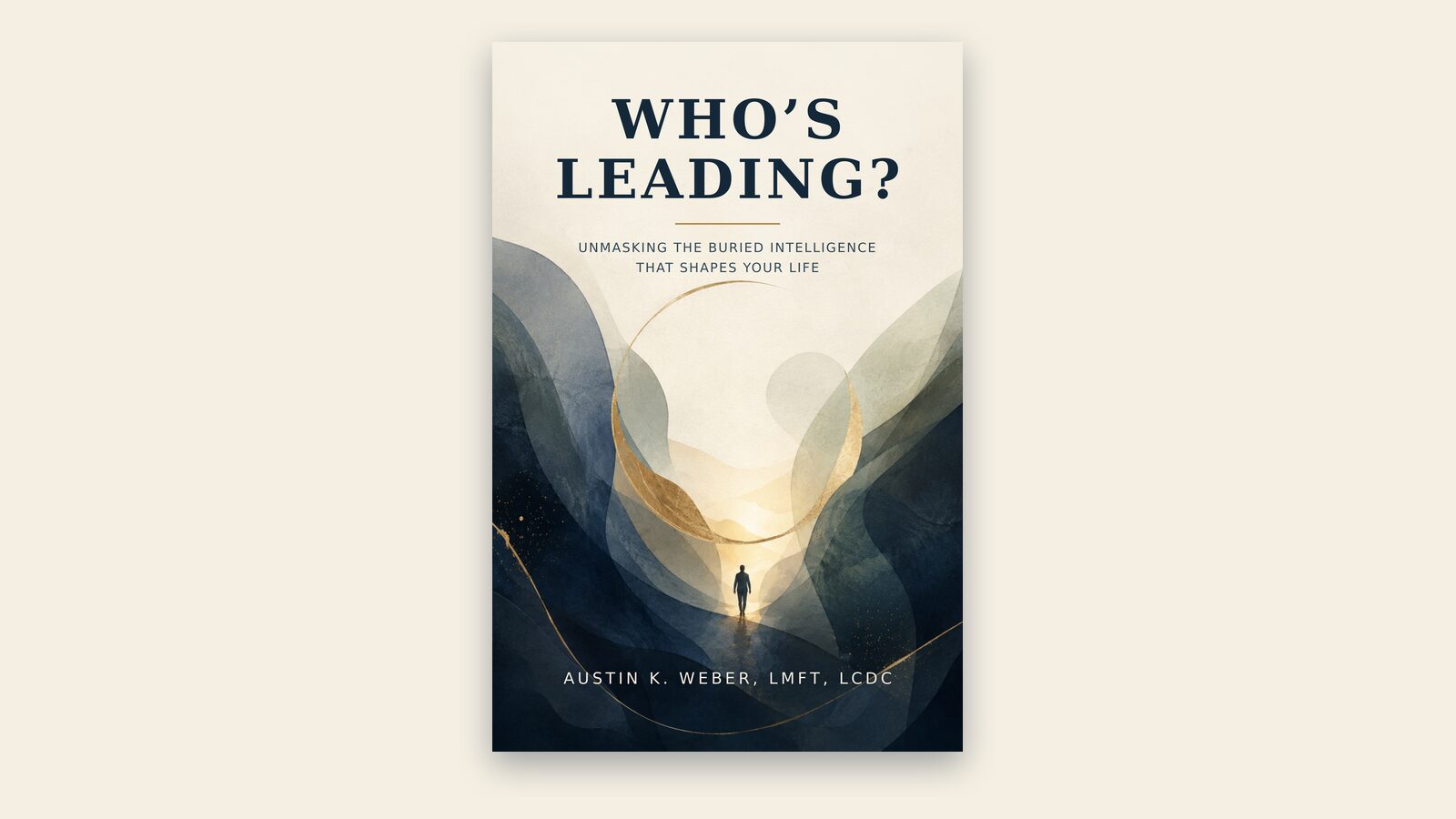
Today my book is out. Who's Leading? Unmasking the Buried Intelligence That Shapes Your Life is available in paperback and on Kindle: Who's Leading? on Amazon.
I wrote it, and I did not build it alone. The framework at its center, Unmasked Leadership, took its shape in collaboration with my colleague Sara Veillon, LPC. Sara is its co-creator and the book's editor, and she wrote the foreword.
Where the book started
Again and again, clients would reach a real understanding of themselves and then ask me a simple question: What do I do with this?
They could see the childhood experience beneath a reaction. They could name the fear driving a conflict. They understood why the pattern existed, and the understanding still did not tell them what to do next. Insight mattered. Insight alone was not enough.
The book is my answer to that question. It is a map for noticing what has taken the lead inside you, understanding what it is trying to protect, and choosing how you intend to respond.
What is in it
- Thirteen chapters in five parts: The Internal Governing System, The Agents of Protection, The Unmasked Leadership Process, Leadership in Life, and Embracing Death for Life.
- Exercises in every chapter, most of them under the heading "Try It", so each idea comes with something to practice on a real moment from your own week.
- A quick-reference guide that gives every term a plain-language meaning and one useful question, and a one-page diagram of the whole system.
- Maya and Daniel throughout. They are a fictional composite couple with two children, Sophie and Eli, and you follow them from the contractor argument to the kitchen counter at the end of chapter 12.
Who it is for
Sara put it best in the foreword: "You do not need a clinical license to use it. You need only a moment when your reaction was bigger than what caused it, which is to say, you need to be a person."
It is for the person who says yes when their whole body means no, and for the one who shuts down while someone they love is still talking. It is for couples who have the same fight in different clothes, for parents who hear an old order come out of their own mouth, and for anyone whose protection works well at the office and costs them at home. Read it for recognition, not diagnosis. Keep what fits.
Three chapters the series did not cover
The posts so far walked through chapters 1 to 10. The last three are where the work leaves the therapy room and meets a whole life.
When old protection comes back
Chapter 11 starts with a plain sentence: stopping is not the same as healing. Stopping a behavior matters, and it may save a life. But a drink, an affair, a work pattern or a screen may have been doing a job: reducing distress, providing belonging, interrupting shame. When the behavior stops, the job is still there. Recovery asks what the behavior was protecting and what can do that work now without repeating the harm.
The chapter also looks at work, where protection is easiest to mistake for virtue. The book's Protective Agents are the strategies an old rule uses to keep you safe, and at work they get rewarded: the Performer earns praise and the Controller looks decisive long before either costs anything visible. "A strategy can advance a career while narrowing a life."
Then it takes on what happens when the old pattern comes back. When Daniel is promoted, an old Survival Order, one of the rules written long ago to prevent an earlier pain, wakes up: Prove they did not make a mistake choosing you. He works late, says yes to everything, hides how overwhelmed he is, and drinks and scrolls at night. Maya's Controller starts tracking his hours. This time they treat the return as intelligence, not proof that nothing changed. Maya says, "I will not manage your schedule or monitor your drinking. I do need honesty, follow-through, and a plan that protects the children and me."
The book's measure of growth is "the shape of the return" rather than permanent absence. Did the pattern last five minutes instead of five days? Was support called sooner? Was the truth told before it was discovered? The chapter offers a return protocol you write before you need it: stabilize immediate risk, name the event and the body signal, identify the Agent and the old order, assess impact, reconnect with support, repair what can be repaired, and change the environment as well as the insight. The book is plain that dangerous use, withdrawal, self-harm or violence needs professional or emergency care, not reflection alone.
The life you intend to lead
Chapter 12 turns to the deadline under all the others: life is limited. The book offers mortality as one possible lens, not a hidden cause behind every ambition. When it fits, it exposes a favorite promise of what the book calls survival propaganda, an old fear's predictions dressed up as fact. The promise is later. Later I will rest. Later I will tell the truth. Later I will repair.
"The message is not that nothing matters because life ends. It is that choices matter because time is limited."
The military has a phrase for deciding under pressure: prioritize and execute. Inside a person, that becomes one question: What is the most important value to protect right now? Choosing one direction means saying no or not now to others, and the book does not pretend otherwise: "Every meaningful yes includes other lives not lived." I wrote about death anxiety in an earlier post, Death Is Not the Enemy; chapter 12 takes that idea further.
Maya and Daniel's story ends here, years on, after Maya receives a serious but treatable diagnosis and both of their old systems become efficient and lonely. They sit at the same kitchen counter where the contractor argument began, and this time neither asks the other to erase uncertainty. The chapter closes:
"The contractor was never only a contractor. The closed door was never only a door. The promotion was never only work. Each moment revealed an older government attempting to lead a present life. By learning to identify who was leading, Maya and Daniel gained something more useful than permanent calm: the ability to return, revise, and choose again."
A constitution and an oath
Chapter 13 asks you to write down how you intend to govern yourself when the old protection returns, because it will. "A constitution is not a promise that protection will never return." Its articles cover truth, voice, limits, orders, repair, return and meaning, with prompts such as My Protective Agents are honored for ____. They are no longer authorized to ____. and Because life is limited, I will no longer postpone ____.
There is a warning built in. If your constitution demands permanent calm, perfect honesty or immediate forgiveness, the Perfectionist may have helped write it. And "a constitution that cannot be revised becomes another old order."
The book closes with the Leadership Oath. It opens:
I will not shame the system that helped me survive. I will not allow its history to excuse the harm it causes. I will listen for the messenger beneath the mask, question the propaganda, update the order, and choose what the present requires.
If you are new to the series
Each post covers one or two chapters and stands on its own:
- Part 1: the question beneath the reaction, and why an ordinary question can set off an outsized one.
- Part 2: the official story we tell about ourselves, and how the old rules first get written.
- Part 3: the Shadow Agent, the old message that arrives as a sudden feeling, and what it may be carrying.
- Part 4: how a Survival Order is written and slowly starts to feel like identity.
- Part 5: the Protective Agents, from the Controller and the Performer to the Pleaser and the Withdrawer.
- Part 6: slowing a reaction into steps you can see, and the Leadership Pause.
- Part 7: unmasking what protection was hiding and writing a new Protective Order.
- Part 8: why couples have the same fight over and over, and the pursue-withdraw loop.
Working through it with others
Mental Health Counseling Group is bringing the framework into Who's Leading? workshops: guided reflection, exercises and honest conversation. Bobby C Johns Jr, a certified life and relationship coach, will help Sara and me lead them. Coaching and personal training are not counseling, therapy, or health care, and are not covered by insurance. Watch the workshops page for dates.
What the book is, and is not
Who's Leading? is educational. The framework is a metaphor and a proposed model, not a diagnosis, a proven treatment, or a claim that literal agents live in your mind, and Maya and Daniel are a composite written to protect privacy. Some chapters touch grief, addiction, mortality and harm in relationships, so go at your own pace. If you are in crisis, call or text 988, or call 911.
Questions people ask about the book
Where can I get Who's Leading?
Who's Leading? is available on Amazon in paperback and on Kindle.
Who is Who's Leading? for?
Anyone whose reaction has ever been bigger than what caused it. It is written for ordinary readers, not clinicians: people who understand why they react and still do not know what to do next, couples caught in the same argument, parents who hear an old voice come out of their own mouth, and people whose old protection returns under pressure.
Do I need to read the blog series first?
No. The series walked through the first ten chapters ahead of the launch, but the book stands on its own. It also holds the last three chapters, the full exercises, the quick-reference guide and the whole of Maya and Daniel's story.
What if an old pattern comes back after I have worked on it?
The book treats a return as information, not a verdict. Recurrence does not prove that nothing changed. The more useful questions are how quickly you recognized it, whether harm was interrupted, whether repair happened, and what pressure made the old rule believable again. High-risk behavior still needs real safety planning and professional care.
Is the book a substitute for therapy?
No. The book is educational. Its framework is offered as a map and a metaphor, not a diagnosis, a proven treatment protocol or a replacement for working with a qualified professional. If what it brings up feels overwhelming, that is a good reason to talk with a therapist.
If you would rather not do this work alone, you can read about my work or Sara's, look at individual counseling or couples counseling, or get in touch.
The book ends on a question, and it is the one I will leave you with: Who will lead now?